Best AI Search Engine for Product Site Founders in 2026
Find the best AI search engine for product site founders in 2026 to improve AI search visibility and secure citations in buyer questions.

Mike Du
Founder, SiteSeed
· 9 min read
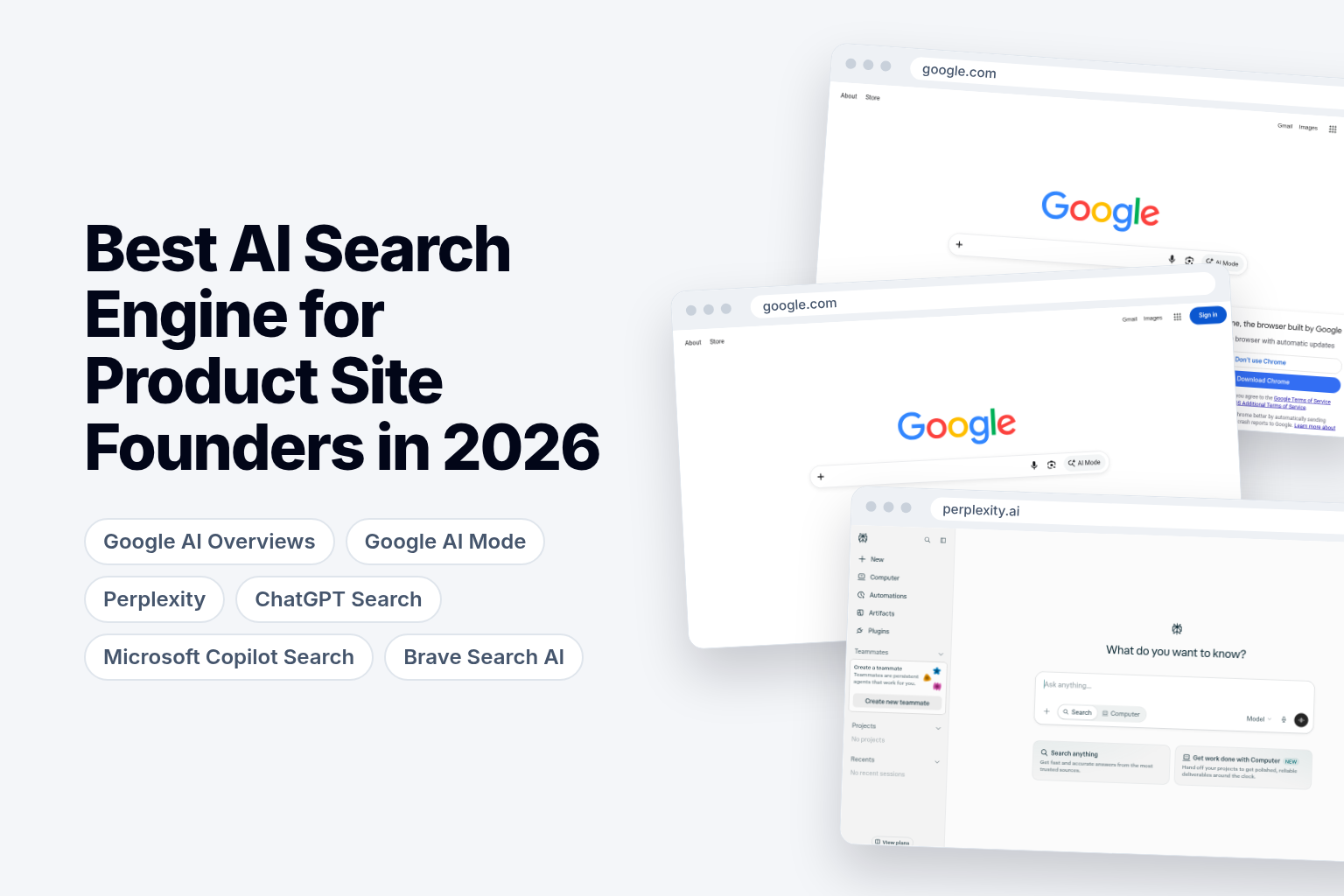
The best AI search engine for a product site founder in 2026 is the one that surfaces your crawlable, source-backed pages with clear citations, not the chatbot with the most features. Seven engines matter for buyer questions, and each handles citations and product content differently. Below you'll see how, and what a small team can publish and check to become a cited source.
What the best AI search engine actually means for product site visibility
Some answer engines cite sources and some don't, and that difference decides whether a buyer can find you. Google's AI Overviews and AI Mode document says AI Overviews use a customized Gemini model together with Search quality and ranking systems and the Knowledge Graph. Google Search Central adds that content should be publicly accessible and crawlable so its systems can provide grounded responses.
On the citation side, OpenAI's help center says ChatGPT Search responses may include citations that users can select to open sources. Your lever is publishing specific, source-backed answers these systems can ground.
How Google AI Overviews and AI Mode differ for site visibility
Google runs two surfaces, and they aren't the same. AI Overviews combine a customized Gemini model with Google's ranking systems and the Knowledge Graph, according to Google's own document. AI Mode is a different experience: the Google Blog describes it as a redesigned Search experience for complex, multipart and follow-up questions, with AI-powered responses and links.
AI Mode can also use shopping data for more than 50 billion products, plus real-time web information and Knowledge Graph facts. If you sell products, check your listings and comparison pages against both surfaces separately. Both rely on content Google can crawl.
AI Search Engine compared
| Engine | Free access | Citation and product strengths | Best for |
|---|---|---|---|
| Google AI Overviews | Not stated | Gemini model plus Search ranking systems and Knowledge Graph | Founders with crawlable comparison content |
| Google AI Mode | Not stated | Shopping data for more than 50 billion products | Complex buyer questions with product data |
| Perplexity | Free $0/month plan | Inline citations on every answer | Founders wanting visible citations |
| ChatGPT Search | Free plan available | Citations may appear in responses | Buyers who research in ChatGPT |
| Microsoft Copilot Search | Included with an eligible Copilot license | Included at no extra cost | Microsoft 365 teams |
| Brave Search AI | $5 in free monthly credit for AI-oriented API products | API at $5 per 1,000 requests | Privacy-minded audiences |
| You.com | Free tier, 100 Web Search API queries/day | Domain filters | Small teams testing filters |
Only Perplexity and ChatGPT Search pair a free plan with citation behavior in the facts. Start your testing there.
1. Google AI Overviews: Suits founders who already publish crawlable comparison content
AI Overviews pair a customized Gemini model with Google Search quality and ranking systems and the Knowledge Graph, per Google's overview document. So the pages that feed them are pages Google can already reach.
Google Search Central says content should be publicly accessible and crawlable for its generative-AI systems to learn patterns and provide grounded responses. If your comparison pages sit behind a login or a script wall, fix that first, then write clear, specific answers.
- Best for: Product sites with public comparison pages.
- Limitation: The facts describe no citation format, so you can't count on a visible link on every answer.
2. Google AI Mode: Suits founders answering complex buyer questions with product data
AI Mode suits buyers who ask long, layered questions. Google describes it as a space for complex, multipart and follow-up questions asked in natural language, answered with AI-powered responses and links. It can draw on real-time web information, Knowledge Graph information and its shopping data, per Google's overview document.
Write pages that answer one product question each, with specs stated plainly, so they can support a multipart answer.
Google also introduced agentic capabilities for tasks such as finding restaurant reservations.
- Best for: Sellers with products in shopping data.
- Limitation: The agentic features were announced as a Labs experiment for Google AI Ultra subscribers in the United States.
3. Perplexity: Suits founders who want every answer to include inline citations
Perplexity's pricing page says every answer includes inline citations showing where claims come from. That makes it easy to see whether your page is being used. The free plan is search with accurate answers and citations, with limited daily usage.
Perplexity's help center says Pro provides 10 times as many citations per answer. Paid tiers also include 400+ app connectors, and Max costs $167/month when billed annually. Publish verifiable articles with named sources, then ask Perplexity your buyers' questions.
- Price: Pro starts at $17/month when billed annually.
- Free plan or trial: Free $0/month plan available.
- Best for: Founders who publish source-backed articles.
- Limitation: Free usage is limited daily, and more citations per answer need Pro.
4. ChatGPT Search: Suits founders whose buyers already use ChatGPT for research
OpenAI's help center says ChatGPT Search is available on Free, Go, Plus, Pro, Business, Enterprise and Edu plans, so most of your buyers can reach it. Responses may include citations, and users can select them to open sources or select Sources to view cited links.
Test it with your real buyer questions and record whether your pages appear. The ChatGPT pricing page lists a free plan.
- Free plan or trial: Free plan available.
- Best for: Teams whose buyers research in ChatGPT.
- Limitation: OpenAI warns that search results and citations can be incomplete, outdated or incorrect.
5. Microsoft Copilot Search: Suits founders inside Microsoft 365 ecosystems
Microsoft Learn says Copilot Search is available to users with an eligible Copilot license and costs nothing extra, since it's included with that license. That matters if your B2B buyers work in Microsoft tools.
Microsoft lists Microsoft 365 Copilot at $30 per user per month when paid yearly, or $31.50 per user per month when paid monthly.
- Price: $31.50 per user per month paid monthly, or $30 per user per month paid yearly, for the Microsoft 365 Copilot license.
- Best for: B2B sites whose buyers use Microsoft 365.
- Limitation: Advanced enhancements such as Copilot connectors may incur additional costs and separate licensing.
6. Brave Search AI: Suits founders who value privacy controls in discovery
Brave AI emphasizes privacy controls over whether chats are retained on servers, whether models train on user chats, and whether IP addresses are retained in chat requests. If your audience cares about that, it's worth testing.
This one is partly a developer product. The Brave Search API page lists complete search results with extra LLM context for AI at $5 per 1,000 requests, and Brave says its AI-oriented API products include $5 in free monthly credit.
- Price: $5 per 1,000 requests for the API.
- Free plan or trial: $5 in free monthly credit.
- Best for: Privacy-minded audiences.
- Limitation: Pricing is per request, so heavy testing uses up the credit.
7. You.com: Suits founders testing domain-level filters on a free tier
You.com's pricing page lists a free tier with 100 Web Search API queries a day. It also lists highlights, knowledge, extraction and domain filters. Like Brave's, this is developer-facing search, not a consumer answer engine.
Use the daily allowance to run your buyer questions with a domain filter on your own site.
- Free plan or trial: Free tier with 100 Web Search API queries/day.
- Best for: Small teams experimenting with domain controls.
- Limitation: The free tier caps you at 100 queries a day, so larger test runs need a paid upgrade.
How to choose the right engine for your product site
Match the engine to your buyers. If your pages already rank in classic search and you sell physical products, start with Google AI Overviews and AI Mode. If you can publish source-backed comparisons, watch Perplexity and ChatGPT Search for visible citations. If your buyers live in Microsoft 365, look at Copilot Search.
Then test each one yourself: type the exact questions your buyers type and note whether your pages appear with links. SiteSeed plans, writes, fact-checks and publishes articles to your existing site through its CMS, in autopilot or manual mode, and removes claims it can't verify against sources. No engine guarantees citations, traffic or rankings.
Frequently asked questions
Which AI search engines show direct links back to the original site?
Perplexity and ChatGPT Search both show citations that point to sources. Perplexity says every answer carries inline citations, and OpenAI says ChatGPT Search responses may include them. Google's surfaces draw on its existing Search systems, so your standing in regular search still matters there.
Can a small product site appear in Perplexity and ChatGPT Search answers?
Yes, it can, though nothing is guaranteed. Your pages need to be publicly crawlable, and your claims should be verifiable against named sources. Specific, well-sourced answers give these engines something they can cite, so write them plainly and then check the engines yourself.
What does crawlability have to do with AI search visibility?
Google Search Central states that content should be publicly accessible and crawlable for its generative-AI systems to provide grounded responses. A page those systems can't reach can't be used. Keep your key product and comparison pages open to crawlers.
How can you test whether an AI search engine surfaces your own articles?
Ask each engine the exact questions your buyers would type. Then note whether your pages appear, and whether they come with a citation or link. Repeat the same questions across all seven engines, and keep a simple record so you can compare results after you publish new articles.
What limitations make AI-search citations unreliable?
OpenAI's help center warns that ChatGPT Search results and citations can be incomplete, outdated or incorrect. Treat any citation as a lead to check against the original source. Measure these engines as a discovery channel, not as a promised source of traffic.
The surface you can actually influence
You can't control which engine a buyer picks, but you can publish clear, crawlable answers that name their sources, then ask the seven engines your buyers' questions and see which ones cite you. If you'd like help producing those articles, you can connect your site to SiteSeed and start from there.
Free tools to put this into practice
- SEO Content Plan Generator
Build a week-by-week publishing plan with target keywords, search intent, and topic clusters.
- Keyword Difficulty Checker
See how many people search a keyword, how hard it is, and whether a site your size can rank for it.
- Retrieval Readiness Analyzer
See whether an answer engine can lift a clean passage from your article. Every check cites its study.